Wednesday, June 28, 2017

The Hope and the Tragedy of Transition - A Response to New York Times Columnist David Brooks on his piece by George Packer


A Response to the four Narratives of American Identity Transition as written by David Brooks in his engage of a piece by George Packer

In his New York Times Opinion Pate, Op-ed columnist David Brooks gives his opinion to a speech given by writer George Packer on “The Four American Narratives.” It is a thoughtful, compelling piece which causes one to reflect on the challenges and the gifts of narratives.  David Brooks writes, “In a superb speech to the think tank New America, the Writer George Packer recently argued that there are four rival narratives in America today." 

 "First, there is the libertarian narrative that dominates the G.O.P. America is a land of free individuals responsible for their own fate. This story celebrates the dynamism of the free market. Its prime value is freedom. Packer wrote that “the libertarian idea in its current shape regards Americans as consumers, entrepreneurs, workers, taxpayers — indeed everything except citizens.”

 Second, there is the narrative of globalized America. This is the narrative dominant in Silicon Valley and beyond. “We’re all lifelong learners and work for the start-up of you, and a more open and connected world is always a better world.” This story “comes with an exhilarating ideology of flattening hierarchies, disrupting systems, discarding old elites and empowering individuals.”

But in real life when you disrupt old structures you end up concentrating power in fewer hands. This narrative works out well for people who went to Stanford, but not so well for most others.

Third, there is the story of multicultural America. “It sees Americans as members of groups, whose status is largely determined by the sins of the past and present,” Packer observed. “During the Obama years it became a largely unexamined dogma among cultural elites.”

The multicultural narrative dominates America’s classrooms, from elementary school through university: “It makes the products of these educations — the students — less able or less willing to think in terms larger than their own identity group — a kind of intellectual narcissism — which means they can’t find common ground or effective arguments that can reach people of different backgrounds and views.”

As Packer noted, it values inclusion but doesn’t answer the question, Included into what? What is the national identity all these subgroups add up into?

Finally, there is the narrative of America First, the narrative Donald Trump told last year, and which resonated with many voters. “America First is the conviction that the country has lost its traditional identity because of contamination and weakness — the contamination of others, foreigners, immigrants, Muslims; the weakness of elites who have no allegiance to the country because they’ve been globalized.” 

(From a New York Times Article dated May 26, 2017 by David Brooks) See https://www.nytimes.com/2017/05/26/opinion/the-four-american-narratives.html.
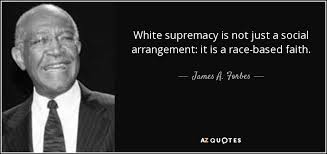

While I would tend to affirm Mr. Packer’s assessment of America, I would add, in my very humble opinion, that one of many factors which unified America, the American Dream, if you will, was the dominance of race, racism, class and a tribalism which ensured a dominant narrative reflective of white culture and society.  America was America because of a peculiar dominance, at times violent, of white supremacy and its historical regime of imagination.  That was the single narrative which was the ground of a secure and steady America. America was about being white, period!  According to a 2015 survey by Anastasia Mechan, a Jewish-Peruvian Journalist and Writer, the U.S. was the number one racist country in the world, see http://anastasiamechan.com/103/.  No secret here that the historical narrative of white supremacy which gained ground on the North American Continent, and the enslavement of the African in America, the genocide of the native American, as well as pogroms to attack, marginalize and eradicate Mexican Americans from America, was the narrative that held America together.  A narrative which is the underlying content of “the campaign slogan, “Make America Great Again.” That said, I suspect this narrative is experiencing a gradual decline or falling away as more and more people awaken and throw off the colonization of white supremacy.  It is to this end that the rise of Trump was made possible as more and more people, particularly those born at the height of white supremacy feel displaced in a world which no longer mirrors them and their imagination, a world no longer made in their image.  This has also been the cause of a spike in racial and religious incidents against a public becoming more and more polarized.

I suspect that there are some who are experiencing lament or sorrow because white supremacy, as a unifying narrative, and its brand of privilege, may be giving way to a country, and a people in search, rather reluctantly, of themselves after 240 plus years of narcissistic tendency.  This is understandable yet as a nation we must begin to reject this sad truth which has, for good or ill, contoured as a matter of response or reaction American society and culture.    
Historically, it has been the desires, imagination, innocence, ignorance and violence which has shaped much of American society and this has been primarily at the hands of those people who align with white supremacy and its brand of privilege as channeled through some corporations, considered people with free speech, as interpreted by the supreme court. Particularly when you look at some in the corporate media/entertainment, the leading man, the man who saves the world is, often, a white male. One of my favorite movies, “The Matrix” is a movie where the savior of Zion, the last human settlement, the messiah, is a white male. Or Star Trek with Captain Kirk, the always victorious, romantic space warrior, see  https://diversitychronicle.wordpress.com/2014/08/29/star-treks-long-history-of-racism-and-sexism-and-the-new-star-trek-series-planned-for-2015/ White men and women, on average, are often shown in a positive light in comparison to black and brown men and women shown in a lesser or secondary light.  I remember when the Hunger Games came out there was some serious hoopla regarding the leading character.  The complaint was that the leader character was black woman.  See http://jezebel.com/5896408/racist-hunger-games-fans-dont-care-how-much-money-the-movie-made

Transitioning from a narrative, exclusively centered one type of imagination, while fraught with anxiety for many, this should be encountered as a normative matter, is welcomed by many others who long to be free of the exclusivity of that imagination and its gaze.  To move, however complex, into a narrative where all people, as called forth in the book of Genesis and affirmed further in the Apostle Paul’s Epistle to the Galatians, have significant unencumbered opportunities to exhibit a different more inclusive humanity becomes a means to experience a new liberative discourse on practical reality, and to recognize and embrace the sacredness of God’s creation.  

II

We Resist because we are free, We Resist because we love, We Resist as an Obligation to the Soul

Psalm 125

A song of ascents.

Those who trust in the Lord are like Mount Zion,
    which cannot be shaken but endures forever.
As the mountains surround Jerusalem,
    so the Lord surrounds his people
    both now and forevermore.

The scepter of the wicked will not remain
    over the land allotted to the righteous,
for then the righteous might use
    their hands to do evil.

Lord, do good to those who are good,
    to those who are upright in heart.
But those who turn to crooked ways
    the Lord will banish with the evildoers.

I receive solace from Psalm 125 as I reflect on difficulties impressed by a life precarious, embracing a certain and necessary confidence in God as I move through the proverbial Valley of the Shadow of Death of Psalm 23.  It strengthens my moral fortitude as I and others choose to live into and through cultural and societal transition of ontological and demographic import.  Amidst what some might call the terrifying and horrific, there is a call to conscience, a call to awaken, and to rise in the face of those forces of injustice which seek to return the days of “The Cross and the Lynching Tree.”[1] The Blood of Emmitt Till, Travon Martin, Tamir Rice, Eric Garner, Yvette Smith, Michael Brown, Tanisha Anderson, Mesha Caldwell, and Philando Castile cry out from history reminding me of their ultimate sacrifice and compelling a prophetic resistance (Isaiah 2:1-5).  Today, June 27, 2017 there was a report on Democracy Now that the memorial commemorating the brutal murder of Emmitt Till was vandalized.

Prophetic resistance grows out of divine love and is rooted in an obligation to the soul. It is a moral responsibility. It is a means to live a sacred, holy and authentic life.  In this sense, it is a matter of love. We resist because we love. An obligation to the soul is unconditional and this is the guiding truth of prophetic resistance.  Simone Weil, in her book, “The Need for Roots” writes

“This obligation is an eternal one. It is coextensive with the eternal destiny of human beings. Only human beings have an eternal destiny. Human collectivities do not have one. Nor are there, regarding the latter, any direct obligations of an eternal nature. Duty toward the human being as – that is eternal. This obligation is an unconditional one.”[2]

Obligation is universal and global, queering cultural-historical and religious boundaries thus making justice and its implications towards freedom somewhat complicated. That said, the empire of today, the one of race, and its supporting economic and religious structures is the most personal and powerful empire in human history and it too rests on matters of obligation. Yet this obligation is very different from the obligation of the one striving to break free of the oppression and injustice emerging out of the oppressor’s obligation to their own desires. In this context, the oppressor, the one with race privilege, whether systemic or historical is the empire which must be overcome to liberate and sooth the soul, this should be received as an obligation. 

Obligations, no matter the challenge or difficulty inevitably lead to the tools which are necessary to successfully transition into a different, inclusive and enlightening imagination. Obligations thus becomes the ground of movements which challenge and eventually overcome regimes of oppression.  Movements such as Black Lives Matter, the Occupy Movement, the Arab Spring, the African National Conference (ANC), the LGBTQ Movements and others arise as matters of liberation and this as a matter of obligation to the soul. These movements and others shout loud the words, I have an obligation to my liberation, my freedom and to love myself and others in Christ.

“Forward Together.” Rev. Dr. William Barber

Prophetic resistance, is a means to fulfill an obligation to the soul, it is a divine call to love, it is the life of Christ Jesus and the revelation of his crucifixion. In this sense, prophetic resistance happens in the context diverse spiritual and religious communities of faith, transcending significant barriers intended to maintain profound and manifest injustice.  Prophetic resistance must open the mind to new and different possibilities of liberation which transcend the narrow confines of definition, character and structure. Mindful of the Civil Rights Movement of the 1960’s prophetic resistance was a matter of oneness with God and with those on the journey together as they fought against men like Bull Conner, George Wallace, the KKK, and the White Citizens Council. What Jesus was up against so to his Church would also face similar persecution.

According to John 17:21 Jesus prayed the following prayer, “I pray that they all may be one, just as you and I are one. Father, I am in you. And may they be in us so the world would believe you sent me.”

These tools necessarily lead to spiritual, mental and emotional clarity for those obliged. The implications of this obligation are horizons of hope revealing a new and different inclusive narrative of humanity.  This obligation reveals itself more and more as a oneness engulfs the whole movement of Prophetic Resistance.

III

Historical Knowledge Compels Action, Strategies and the Architecture of Hope

I was recently part of a teach-in at Laney College in Oakland, CA. I was there to sit on a panel discussing issues and concerns of healthcare, education, the LGBTQ community, immigration, and employment. Our discussion reminded me that one of the most critical elements of a discussion on social justice is the historical analysis which must be the starting point of any action to adequately and successfully address issues and concerns of injustice. An historical analysis will reveal systems, processes and the constructs which maintain the grand narratives which dictate and frame life as it is today. Of course, history as a curriculum in public schools, and education in general, has been under considerable pressure for years as budgets focus more and more on subjects more in line with corporate and right-wing interests.

“Simply put, life is a journey through history.”

The sorted history of the United States compels me to be faithful and watchful as day after day grace and mercy become a way of survival in a society not my own. As Lebron James, one of the greatest basketball players of all time said after his house was vandalized with a racial slur, “No matter how much money you have, no matter how famous you are, no matter how many people admire you, being black in America is tough. We got a long way to go for us as a society and for us as African-Americans until we feel equal in America.” See https://www.theatlantic.com/news/archive/2017/05/lebron-james-responds-to-racist-vandalism-of-his-la-home/528771/. I suspect this experience is encountered by many black and brown people who successfully navigate and even transcend a world imagined and constructed exclusively for white people.  The one who accomplishes particular mastery of this white world, who overcomes Franz Fanon’s white gaze, finds a peculiar freedom and burden which characterizes their pursuit, their divine calling.

That said, it is clear to me that transitions whether personal, familial, cultural, social or political, economic reveal significant fault lines which portend significant and necessary shifts, putting at risk certain grand narratives which have historically defined American society, considered by this writer as a grand overarching structure, as white.

Grand narratives as defined by postcolonial theologian Marcella Althaus-Reid in her analysis of Antonio Francesco Gramsci, an Italian Marxist political theorist, are those authoritative discourses which sustain everyday life.  They identify the common order or common sense of things which are ideologically constructed yet assumed to have a natural and almost biological presence in life.  These are the Cultural, religious, socio-political discourses, economy and science and philosophical cosmovisions.[3]  Although she was referring to Latin America, the same would apply to the United States.

As difficult and fraught with complexity as transitions can be they provide an opportunity for society to redefine itself and its mission and hopes sought. To somehow delink itself from narratives unhealthy for the whole and to move forward together with a new, steady and just inclusive vision for a common good. The process of transition is not easy or at times manageable yet for the growth and maturity of a nation certain navigation of the transitory is necessary.  Unless this is accomplished nations cannot achieve the fullness longed for by their founders.

Conclusion


The true and most sincere measure of a society is how it treats the least of its citizens. It’s not how much money corporations make their shareholders or how big its military is or how many times it can destroy civilization. More so, it is how it treats its children, the infirmed, the disabled, the homeless, those with mental health challenges and the unemployed.  It is how it treats the sacred and divine things of God.  A society which neglects such will soon falter, indeed it will eventually fall. Transitions are that moment in time when societies choose to acknowledge the divine in all people or shrink from matters courageous. As a country of people we must take this time seriously and move steadfastly with intention to a brighter future.


[1] Cone, James, H., The Cross and the Lynching Tree, Orbis Books (Maryknoll, New York)
[2] Weil, Simone, The Need for Roots (Routledge, New York) p. 5
[3] Althaus-Reid, Marcella, Indecent Theology, Theological Perversions in Sex, Gender and Politics (Routledge, London, UK) p 11.

Tuesday, June 27, 2017

A Moral Dissent on the Senate Republican Healthcare Legislation


The current republican healthcare insurance legislation on the floor of the senate inflicts political violence upon Americans as according to the Congressional Budget Office (CBO) it will take away insurance from 22 million people over the next ten years, cut Medicaid by $772 billion while giving the 400 richest families a tax cut worth on average $7 million each, and according to the Annuals of Internal Medicine be the cause of early death of over 28,000 people per year. Senator Bernie Sanders of Vermont in a statement on the floor of the Senate called the legislation “barbaric and immoral.” The elderly would also have to pay five times more than young people, this according to the Guardian.  Further, according to a 2013 study done by Nerdwallet study which employed a 2009 Harvard study there were 643,000 medical bankruptcies per year (http://www.snopes.com/643000-bankruptcies-in-the-u-s-every-year-due-to-medical-bills). The elderly will have to pay five times more than young people for their healthcare insurance, see the Guardian at www.theguardian.com/business/2017/mar/15/elderly-americans-healthcare-new-bill-republicans . While the Affordable Care Act (ACA) or Obamacare sought to alleviate this burden the Republican healthcare insurance legislation on the floor of the senate will exacerbate that burden necessarily increasing the number of Americans living in poverty. 

According to a New York Times article of June 23rd entitled “The Health Debate Shows What Both Parties Care About Most” states that Republicans are focused on trying to minimize taxes, especially on investment income, and keeping federal subsidies for health care to a minimum. They are willing to accept the wrenching consequences that attaining those goals might have for Americans’ insurance coverage, betting that lower taxes and smaller government will fuel a more vibrant economy.” They believe that their ideas of free market solutions are worth putting the healthcare of the American people at risk. In contrast, the Democrats are focused on trying to maximize the number of people who have decent health insurance, and are willing to accept whatever tax increases and arrangements with health insurers and other private interests are needed to make that happen. They seek the broadest possible availability of health care, whatever the cost and political trade-offs it takes to achieve it. See (https://www.nytimes.com/2017/06/23/upshot/the-health-debate-shows-what-both-parties-care-about-most.html. I believe the Republican legislation misses the point.  It’s not about the money exclusively, more so, it is about life, death, family and those relationships that make life worth living.  Healthcare must be considered a common good.

As a veteran and recipient of single payer, and a pastor in the Christian Church Disciples of Christ and transgender, with people in my congregation who live with disabilities, the infirmed, the elderly, homeless and those with mental health challenges, I find very little, if any, compassion, hope or justice in this legislation. It reveals a peculiar deficit in morality and good judgement. Believe it or not, the Republicans on Capitol Hill, as much as they accused the Democrats of setting up death panels, have themselves become a type of death panel consigning to death thousands of people per year while lining the pockets of 400 hundred wealthy families according to the Huffington Post. It does not reflect the reality that healthcare and healthcare insurance is a common good, that beyond political, economic, and religious persuasion, all people have a right to healthcare and healthcare insurance.  As a person of faith, I look to the example of Jesus Christ as he gave free healthcare to all and did not charge any premiums.  His example reminds us that the God that many Republicans use as a talking point to support policies detrimental to poor and working families envisions healthcare and healthcare insurance as a divine and sacred right not to be hindered by those who see healthcare to make profits for shareholders.

Isaiah 10:1-4 says Ah you who make iniquitous decrees who write oppressive statutes to turn aside the needy from justice and to rob the poor of my people of their right, that widows may be your spoil, and that you may make the orphans prey! What will you do on the day of punishment in the ruin that will come from afar. To who will you flee for help, and where will you leave your wealth? Nothing remains but to crouch among the prisoners or fall among the slain. For this anger has not turned away and his hand is stretched out still.

I suggest here that in the final analysis those who use sacred scripture, the word of God, to further the oppression the American people for the benefit of profit shall reap the wrath of God. There is a price to pay for a legislation unjust.

While I look to scripture to inform my political persuasion I am also mindful that the need to repeal and replace the Affordable Care Act (ACA) or Obamacare is a promise made during the campaign, to tear down as much as possible the political legacy of President Barack Obama. I would be remiss if I did not consider this unfortunate and sad reality, that 22 million people are put at risk because of the incessant need to tear down President Barack Obama's legacy.  I remember looking at a piece on VOX media where a woman living in Kentucky, a Trump supporter said that the “Affordable Care Act saved her life but when told that her healthcare insurance was subsidized by the government she immediately said she detested Obamacare.” To be clear, it’s not just the Republicans on Capitol Hill but many of their constituents who hate President Barack Obama.

And because of a need to tear down  President Barack Obama's legacy healthcare for 22 million Americans, the consigning to early death of over 28,000 Americans, 643,000 medical bankruptcies and a multitude of implications to increase in poverty is made possible. Sadly, I believe hatred and racism are the underlying unspoken reasons for this profound injustice. I am obligated because of my faith, because of my love for justice and the common good for all people to a moral dissent regarding this piece of abhorrent legislation and pray that the hearts of those in favor of such legislation would be made new regarding this important and critical matter of healthcare for all.

Tuesday, May 23, 2017

Drawing Closer to God


I have been blessed to live among a community of people who have a mature and unwaiverable faith. A faith rooted in their relationship with God, through Christ Jesus.  They remind me daily that whatever joy, suffering, pain and the many challenges of this life, though at times significant, fall asunder in the face of the magnificent love of God through Christ Jesus. Life, in the final analysis, it would seem, is a means, a way, to encounter, to draw closer to God, if chosen. Psalm 66:8-20 and Acts 17:22-31 each present that person’s experience of God.  David expressed a solitary, at times a mystical experience of God or the Apostle Paul, whose experience was more often communal and what might be considered urban, at least according to the scriptures.  Both David and the Apostle Paul present us with a different, yet genuine closeness to God. It is to this end that we visit the book of James today.

The Epistle or letter of James to the twelve tribes in dispersion (that is Israel regardless of whether all twelve tribes existed or not, the whole of spiritual Israel) reminds us today that if a Christian desires to draw closer to God they must not be friends with the world.  In fact, if they seek to be friends with the world, to access the things of this world, then they become enemies of God, complicit in a collective rejection or denial of God. (James 4:4) Living in a  society based on the acquisition of capital with a need to access the things of society to survive, to make a living, this becomes a challenge.  Considering their relationship with God and God’s word the Christian engages the world knowing that each engagement can put their soul and their closeness with God at risk.  James then must be considered an appeal to the Christian for the sake of their soul, their relationship with God and the implications to their actions. We pray God’s grace and mercy in these matters!

The great call of this life is to draw closer to God. The Christian does this by humbly seeking to live justly and ethically with integrity in a dynamic and inclusive community with their sisters and brothers, [to be Christ like].  While the call of life to draw closer to God begins as a solitary conversation within the heart of the Christian the eventual closeness to God in the Christian is profoundly expressed in community.  Rev. Dr. Howard Thurman, a Christian mystic of the 20th century in his book, “Creative Encounter writes,

Religious experience in its profoundest dimension is the finding of God by the individual. This is the witness. The moral quality is mandatory because the individual must be genuine in their preparation, motivation, and response. Their faith must be active and dynamic.  

                                                                                    Howard Thurman


For me the words of Howard Thurman bring into sharp focus a faith that is active and dynamic, calling into my consciousness those things considered impediments or a hindrance to the witness of the Christian community, its faith and the desire to draw closer to God. Impediments are those actions, ideas, imaginations, reflections, such as racism, patriarchy, sexism, homophobia, transphobia and privilege, to name a few, which have their root in culture, society, politics and sadly even some churches, which seemingly deny or outright reject the inclusive and justice oriented message of the gospel of Jesus Christ.  The greatest of these impediments is hypocrisy. Both the Apostle Paul in his Epistle to the Galatians and James in his Epistle to the twelve tribes of Israel remind the Christian that there is only one gospel and only Christ shall be lifted.  Mindful of the struggle to build a more inclusive Church I am reminded of the words of The Rev. Dr. Martin Luther King, Jr., who said "it is appalling that the most segregated hour of Christian America is eleven o'clock on Sunday morning." Although his lament was made over 60 years ago, the question remains open.  How much have things changed?

There are some people who claim to be close to God, displaying the traditional rhetorical trappings of the Christian faith, but fail to follow the teachings of Jesus Christ as he lived them out and as written in Galatians and James. They ask, “What Would Jesus do?”, and then go against the very teachings they supposedly seek to follow, standing firmly in that which obstructs the gospel.  They exhibit an outrageous hypocrisy, putting millions at risk of losing their healthcare benefits so that the wealthy and privileged class might get a tax break at the hands of some who claim Christ as Lord and savior.  In a recent interview on MSNBC’s AM Joy, Rev. Dr. William Barber, a Disciples of Christ Pastor, and President and Senior Lecturer of Repairers of the Breach stated, in response to Kansas Representative Roger Marshall's horrible comments on the poor, healthcare, and Jesus, and Rev. Barber did not hold back, He said, “If Jesus did anything he set up free healthcare wherever he went and didn’t charge a premium.” I suspect Jesus might favor single payer! Without question, some in the Christian community continue to embrace the impediments which deny the message of the Gospel of Jesus Christ.  The challenges of today are not new but reveal one more thread of an ongoing political and theological discourse on the dignity, value and sacredness of all people.  That said, the mere passage of time alone will not relief the suffering so many experience.  As MLK said, “Change does not roll on the wheels of inevitability, but comes through the continuous struggle of man.”

Today, as in times past, there is profound need to draw closer to God, to lean fully into the bosom of God, to receive nourishment for sustenance, as we walk through the valley of the shadow of death with our sanity intact.  Like the saints who have gone before us in space and time we gain strength, courage and liberation to overcome those impediments which seek to detract from the Christian witness by living into our oneness with God.  Drawing closer to God is a process of intention, grounded in a heart longing for a deeper experience of God’s grace and mercy through the Jesus Christ.  And though I long for this process to happen in secret, in private behind closed doors, it occurs amidst the dynamics of human interactions and intentions.

James 4:7-10 calls the sinner to submit themselves to God.  To clean their hands and to purify their hearts, oh double minded.  Lament and mourn and weep! Let your laughter be turned to mourning and your joy to gloom. 10 Humble yourselves in the sight of the Lord, and He will lift you up. It is as the Christian comes to terms with the issues of their life and this world and the impact the world has upon them, that their character and actions that they realize the necessity of the words of James. The process of closeness to God is a matter of repentance, as the Christian, humbly seeking God gives their whole selves to God. 

The implications of Drawing closer to God are (a) a change in vision, i.e. the way we see the world, (2) a change in questions asked, (3) a life transformed (4) a new focus on concerns regarding things which matter to God and (5) a hopeful and steadfast attitude.  Like Simone Weil, a French philosopher and mystic of the early to mid-20th century, there is a different sense of attention, engagement and the indwelling spirit.  

Psalm 63, A Psalm of David reads


O God, you are my God, I seek you,
    my soul thirsts for you;
my flesh faints for you,
    as in a dry and weary land where there is no water.
So I have looked upon you in the sanctuary,
    beholding your power and glory.
Because your steadfast love is better than life,
    my lips will praise you.
So I will bless you as long as I live;
    I will lift up my hands and call on your name.

My soul is satisfied as with a rich feast,[a]
    and my mouth praises you with joyful lips
when I think of you on my bed,
    and meditate on you in the watches of the night;
for you have been my help,
    and in the shadow of your wings I sing for joy.
My soul clings to you;
    your right hand upholds me.

But those who seek to destroy my life
    shall go down into the depths of the earth;
10 they shall be given over to the power of the sword,
    they shall be prey for jackals.
11 But the king shall rejoice in God;
    all who swear by him shall exult,
    for the mouths of liars will be stopped.


Like David, it is by drawing close to God that the Christian overcomes whatever issues or concerns which pervades their life, that holds them back from the grace which strengthens.  It is as the Christian draws closer to God that their soul we be at rest.  Amen!!  

Tuesday, April 18, 2017

The Problem


Those with privilege must be careful not to become lax in their thinking.  If there thinking is lax there is a distinct possibility that someone like Mr. Trump could run a scam that would do profound and severe harm to them and others.  They are ripe for manipulation and useful as pawns for intent unbecoming.  A lack of thinking, more so a lack of critical thinking, is detrimental necessarily putting at risk delicate narratives sensitive to economic, cultural, social, religious and political liabilities. Those in this mental predicament, (ex. a Trump supporter), seldom see, without significant intervention, the harm it will do to their own standing, be it economic or another context such as the Affordable Care Act, i.e.., Obamacare.  In contrast those on the margins, the ones threatened by Mr. Trumps rhetoric during the campaign have, often, had to embrace critical thinking, to be cunning, to recognize the abuse, present as well as historical perpetrated by those privileged and unconscious of desires grounded in that privilege to maintain the status quo.  Those privileged, suckered by a man who is more and more seen as an unwitting operative of Russia and Vladimir Putin (The Hill, August 2016 and Washington Post December 9, 2016) could employ strategies which could take that privilege and use it his advantage to ultimately win the Presidential election.  While many of us could see through Mr. Trump’s scam sadly there were many who were unable to see through them and we look to be worse off for this.

That said, those of us concerned should stand tall, ready to keep Mr. Trump’s policies in full view of the public for the sake of our democracy  


The Rise of Trump, and a stock market which seems to look positively at his possible presidency, reminds me that capitalism, white supremacy and white privilege are connected at the heart.   This is the difficulty that consumes conversations which seek to engage a different more equitable and just economic system.  If we can delink white identity at an institutional level from the economics policy equality might emerge for all.

Sunday, April 16, 2017

Why the celebration of Easter? The Resurrection of our Lord and Savior Jesus Christ


The title of this message was posed to me by my doctor during a minor operation this past Monday.  The doctor knew me as a pastor and minister of the gospel so the question wasn’t unexpected or out of the ordinary.  It reminded me that questions can offer moments of profound clarity as an embodiment of grace for the one who asks the question and the one providing the response.  My response to her question was that I celebrate Easter because it commemorates the resurrection of my Lord and Savior Jesus Christ, that whatever hope there is in my life I live in Jesus Christ. She said she had asked because she was beginning to teach her children about Easter and the reason why it is so important. She said she had been raised in a Christian family but now she wanted to pass on what she had learned as a child.  I don’t know about you but conversations can bring back some serious memories, reminding me of the song, “Back down Memory Lane” by Minnie Riperton, and my mother and father living out the lyrics of, You’ll Understand It Better by and by” when I didn’t want to go to Sunday School. The older I get the more I appreciate the teachings of my parents.

The conversation with my doctor called me to reflect on the significance of the Resurrection of Jesus Christ, the Good News and the meaning it has for the church.  Easter, the celebration of the Resurrection of Jesus Christ is a means for us, as followers of Jesus Christ to reaffirm our love, our faith and our trust in the living Christ. We celebrate the resurrection because its message is that through the risen Christ you and I are no longer bound to sin and death, that through the risen Christ we have overcome the world.  It is also a reminder that the Church, you and me, are called to proclaim the resurrection of Jesus Christ, the good news with our lives. 

The resurrection is sure, giving courage to the faithful as they stand against and eventually overcome unjust and burdensome systems, structures and their so-called skinny budgets, which concede nothing without a whole lot of prayer and serious political strategies, while at the same time, seeking to deny the good news of Jesus Christ in favor of powerful corporate interests. In the face of this moral crisis where ignorance is stubbornly lifted high, truth seemingly banished and closed mindedness and polarization the order of the day the resurrection offers new life, new hope, and God’s abundant love. This is nourishment for a life, longing, fighting and struggling to transform an unjust circumstance or situation. The resurrection presents the steadfast, faithful, immovable and those weary with a revolutionary hope as it speaks to the stones of injustice such as racism, voter suppression, poverty, ever increasing medical costs, and homelessness, to name a few, being rolled away from a life precious in the sight of God.  

Mindful of the Apostle Paul, and his Damascus Road experience with Christ in Acts 9, and his many trials and tribulations for the sake of the gospel in 2 Corinthians 11:16-33 and his compelling arguments regarding the resurrection in First Corinthians 15: 1-2 and 12-20-22, 30-32 the Apostle Paul’s experience of the good news, of the risen Christ, became that prophetic fire which compelled him in his love and justice for God’s people resulting in Epistles or letters which form much of New Testament scripture and upwards of 20 churches.  What we have in the Apostle Paul is a man sold out to Jesus Christ.  He moves in Christ alone recognizing that the risen Christ illuminates a new covenant grounded in God’s tenacious and everlasting love which held Paul without waiver.  My impression based on the text is that Paul had apprehended the risen Christ and sought to proclaim the risen Christ he encountered on the Damascus Road. Similar to the prophet Jeremiah in 20:9, there was a fire shut up in Paul’s bones which had to be unleashed for the glory of God. 

My oldest and dearest friend, mentor and colleague recently said, regarding Paul, “You cannot receive the risen Christ and not do something, you’ve got to move.” It’s like fire in your pants.  In other words, there are implications for the one who encounters the resurrection of Christ.  The implications of the resurrection are a matter of awakening to God’s deep and everlasting love for all people, to awaken to the plight of our sisters and brothers and the greater community, to awaken to the many lie’s which seek to deny our humanity, to awaken to the fact that we are blessed and highly favored, to awaken to the reality that social and cultural change will not occur without active participation including resistance, to awaken to those systemic structural economic barriers which maintain wealth and privilege for fewer and fewer of God’s people.  

In Rev. Dr. William Barber’s book, “The Third Reconstruction, “How a Moral Movement is overcoming the Politics of Division and Fear” In the chapter on “Learning to Stand Together” he reflects on the words of Stanley Hauerwas, “The first task of the church is to be the church. Only if the church is the church can people see another way is possible. Without this alternative witness, we are tempted to think that the way things are is simply the way things have to be.”
The Church is called to once again to apprehend the resurrection not just as a celebration but a call to live out the resurrection each day to reimagine a more just, whole and equitable society where all people are received as God’s own.


Friday, April 7, 2017

The Lord may not come when you want Him, but he's always going to be there on time.  Louis Gossett, Jr. (Based on Job 35:14)


Living day by day in a world where joy, happiness; the good things of this life are tempered or balanced by suffering, death; things profoundly unjust, bordering on what might be considered absurd and immoral push many to their knees in prayer.  Life, for some, at times can seem small, without meaning, seemingly denying the glory of God expressed in life itself. Yet, it is from this life, and no other that many cry out, like David in Psalm 130, for some relief, deliverance, healing; something to soothe the pain or to express the joy occupying one’s life at the moment; there is a profound need for a savior.  

The text of John 11:1-45 is skillful as a response to Psalm 130, reminding us today that there is a savior, yet this savior, that is Jesus Christ tends to reconfigure, transform and even frustrate the desires, hopes, expectations and agendas of even the people he called friends, those whom he loved, his disciples, he troubles the waters of a human imagination sequestered at the feet of economic and political interests.  Jesus rarely saves or redeems exactly the way expected.  Reading the text, we encounter the situation of Mary, Martha and their baby brother Lazarus.  According to the text Jesus was well aware of his dear friend’s death and I suspect Jesus being Jesus was very much aware of the anguish and sorrow of Mary and Martha. Yet Jesus took his time saying, “This illness will not lead to death, rather it is for God’s glory, so that the son of God might be glorified through it.”  When Jesus finally arrives at the house of Mary and Martha, Lazarus is wrapped in grave clothes, in the tomb, and dead four days. Interestingly, all through the gospels there is an eagerness even an urgency in Jesus to help, to make well, to heal, to feed, to give sight to the blind, but in this text, we find no eagerness, no urgency more so we find a savior who seemingly treats his friends differently than those who, though also children of God, might not be considered friends or disciples, there was an urgency to help the stranger!  I suspect that Jesus felt that those who had been around him more, who knew him, his disciples, would not lose sight of the mission at hand. Jesus expected more of them that people unaware.

In vs 20-22, Martha approaches Jesus, saying, “Jesus, Lord if thou had been here, my brother would not have died. But I know, that even now whatsoever thou will ask God, God will give it thee.” Martha spoke these words amidst her and Mary’s frustration with him (John 11:20, 28-33). This was not the first-time Mary and Martha were frustrated with Jesus (see Luke 10:38-42). Seemingly, death held a different importance and space for Jesus than it did for Mary and Martha. Yet Mary’s confidence in Jesus far outweighs struggles of human understanding. She has more confidence in Jesus than in the problem which would end with the resurrection of Lazarus by Jesus.

The text begs the question, “How do we hold suffering, dying and death amid a savior who receives these difficult and troubling events, even his own gruesome death, as a means to the glory of God, the resurrection.” I suspect that Jesus doesn’t want to minimize death but seeks to reframe death from a period to a comma. That death is not the end! Why should death be received in this light?  I would imagine, from a philosophical, theological or agrarian perspective death would be a means to new life yet when many encounter, in real time, the death of friends, colleagues, family members it can be mentally and emotionally taxing, demanding, even exhausting, far from thoughts of a bodily resurrection.  Death is one of those topics people rarely ever touch until forced to by circumstances. And then, in some cases, all hell breaks loose. Jesus’ treatment of death would seem to be one meaning of the text and life in Christ that death is a means to new life and in this sense the death and resurrection of Lazarus gives somewhat of a sneak preview of divine things to come. 

The situation of Martha, Mary and their brother Lazarus at Bethany, should not be surprising or unusual as our savior, the eldest son in a single parent household, a carpenter, a onetime refugee due to the dangerous life threatening policies instituted by Herrod (sound familiar), homeless, a person who, because of who he was, knew instinctively that the sacredness of God’s humanity entitled all people to unconditional love, free and universal healthcare, and an abundance of food, to name a few contemporary concerns. Jesus was an unorthodox Jewish Rabbi upending the norms and expectations of his day as he sought to reveal and express the glory of God, to usher in the Kindom of God, thus gradually becoming a threat to both the Roman and Jewish establishments, an enemy of the state but the hope and salvation for a world of people longing for relief from systems and processes which supported the empire.

Mindful of Rev. Dr. William J. Barber’s Barbers book, “The Third Reconstruction” and Archbishop Oscar Romero, assassinated March 24, 1980, in San Salvador, El Salvador because he sought to follow in the footsteps of Jesus, some may find this reading of the text somewhat uncomfortable needing a Jesus and his Church to be complicit in the affliction experienced by many living under the cruel power and authoritarianism of a few for the sake of religious or political gain, cultural animus, wealth, ego and agenda’s. Yet based on the actions of Jesus, read in the text and throughout the gospels, the stance of his Church and those who choose to follow Jesus, must be about the ushering in of the Kindom of God, and in this sense to reveal the glory of God. (Pause)

  The title of today’s message, “The Lord may not come when you want Him, but he's always going to be there on time.” A quotation of Louis Gossett, Jr. Based on Job 35:14 is a reminder that at times there may be a huge difference in the agenda of the one who prays incessantly, fasts and reads scripture daily, and maintaining Christ centered relationships, seemingly doing the right and worthy things of Christian life yet when confronted by life’s circumstances and a God whose touch cannot be felt some become disheartened, asking   “Where is God, Why have you forsaken me or why didn’t God answer my prayer.  The problem may not be the acts or the actions of the Christian but their perspective about the situation or circumstance.  The fundamental question asks of the Christian must be, “Is my thinking, and in this my life about the Kindom of God or the world.  Are my expectations rooted in the Kindom of God or in the world?  Kindom living is not so much about political, material or economic persuasion, more so it is about a way of life, a way of looking at the world as Jesus saw it. While there are many lessons to be gleaned from the text on Mary, Martha and the death of their brother Lazarus it is the lesson of confidence in Jesus.  Jesus Christ is always bigger than the problem yet if our thinking is not Kindom thinking we may miss the very point of life itself.


Saturday, March 18, 2017

Reflections on a Conversation, A Message on Jesus and the Samaritan Woman at the Well


The text today, John 4:1-26, is about Jesus and the Samaritan Woman at the Well at midday in the town of Sychar, a town in route to Galilee, about 40 miles from Jerusalem. It gives us a glimpse of two people engaging in conversation at Jacobs well.  It provides a means to see an encounter of deep listening and a gracious empathetic response to the challenges experienced by a Samaritan woman longing to be heard.  This conversation is also a means by which to see Jesus giving full attention to the words of the Samaritan woman, to experience the intimate encounters of her life.  Simone Weil, a French philosopher, activist and mystic writes in her book Gravity and Grace that attention is the rarest and purest form of generosity. I think attention, often is the question, “Has anyone heard my cry, does anyone even care.

For Jesus to converse with a Samaritan woman, a woman not married, considered a nonperson in the Roman context was a profoundly unorthodox encounter as Jews did not engage in any way with Samaritans.   Further, it was a man’s world and woman, particularly Samaritan woman were outcast and overlooked in most matters.  But for Jesus, speaking to a woman, even a Samaritan woman as a human being was nothing new, this is how he moved in the Roman world. Of course, the Samaritan woman, not being used to being treated as a viable human being with divine importance at first could not fathom the words spoken by Jesus for her suffering and loneliness were heavy upon her, yet the more she conversed with Jesus the Son of God the more she awakened to what Jesus had to offer.  It is at this point her burden of outcast and loneliness was lifted. She had been undone and awakened by Jesus the Messiah to receive living water, a most extravagant grace so deep and soothing that she had to share it with her community.  She had experienced the riches of God’s grace and in the process received the fullness of her humanity.  The apostle Paul was so touched by this extravagant grace, the living water as he writes to Christians at Ephesus

Blessed be the God and Father of our Lord Jesus Christ, who has blessed us in Christ with every spiritual blessing in the heavenly places, just as he chose us in Christ[b] before the foundation of the world to be holy and blameless before him in love. He destined us for adoption as his children through Jesus Christ, according to the good pleasure of his will, to the praise of his glorious grace that he freely bestowed on us in the Beloved. In him we have redemption through his blood, the forgiveness of our trespasses, according to the riches of his grace that he lavished on us. With all wisdom and insight he has made known to us the mystery of his will, according to his good pleasure that he set forth in Christ, 10 as a plan for the fullness of time, to gather up all things in him, things in heaven and things on earth. 11 In Christ we have also obtained an inheritance,[c] having been destined according to the purpose of him who accomplishes all things according to his counsel and will, 12 so that we, who were the first to set our hope on Christ, might live for the praise of his glory. 13 In him you also, when you had heard the word of truth, the gospel of your salvation, and had believed in him, were marked with the seal of the promised Holy Spirit; 14 this[d] is the pledge of our inheritance toward redemption as God’s own people, to the praise of his glory.

                                                                                                            Ephesians 1:3-14


Amid this life, God offers each of us extravagant grace, that is, living water so that our souls might be well nourished and our hopes renewed daily.  Each of us should consider this as we journey through our day recognizing that God has poured out living water through Jesus Christ to each of us.   Like the Samaritan woman at the well we are called into conversation with Jesus Christ.  It may be an unsuspecting encounter or a moment in time when our way seems foggy, cloudy or without light, yet the living water, that extravagant grace is near you, it is very present.  It is in this illuminating light of Christ that the Lenten Season appears calling each of us to reflect on our conversations with Jesus Christ, to, in some sense, like the Samaritan woman at the well, rediscover the fullness of our humanity. We must not take this lightly as we are living in a time when our collective humanity is under attack by forces of profound injustice.  Healthcare, education, the environment, energy, immigration, global warming, and earth herself are all under attack by powers which seek to deny the fullness of our collective humanity and the sacredness of mother earth.  

This past Friday I attended the Earl Lectures at Pacific School of Religion.  The topic for this year’s Earl Lectures was Border Identifies. The keynote speaker was Jose’ Antonio Vargas, a Pulitzer prize winning journalist, activist and undocumented immigrant.  He shared stories of his experiences as an undocumented immigrant and the injustice of the present immigration system.  He described the danger, challenge and the risk many go through as human beings undocumented.  He described the fear, the suffering and the oppression experienced at the feet of an immigration system broken. And though the situation is real it was his faith that has held him. It is his community that maintains his hope.  He reminded me that the writings of James Baldwin collectively say, “I am who I am, deal with it.”  

This is the point of the whole conversation between Jesus and the Samaritan Woman, that she must reclaim her humanity regardless of her position in society and culture.  She was no longer outcast and lonely, searching for meaning, but a child of God in communion with Jesus Christ the beloved the Son of God. The message of “Jesus and the woman at the well” is “Amid a world suffering we must reclaim daily the fullness of our humanity and in the process, defy powers which seek to deny our humanity through unjust, immoral policies reflective of revenge politics.”  Ephesians 6:12 reminds us that our struggle is not against flesh and blood, but against the rulers, against the authorities, against the powers of this world's darkness, and against the spiritual forces of evil in the heavenly realms. Yet amidst those powers which would deny our humanity we have a faith defiant, resilient without apology and in this we stand in the light of the cross and the resurrection.

The Hope and the Joy of the Well

And what is the hope and joy of the well but a love so deep that it overcomes the oppressions which seeks daily to deny the humanity of God’s people. The hope and the Joy is the good news shared by many which gradually, with intention reveals the Kingdom of God to a world in need of God’s extravagant grace.